


The two most important questions a family asks when they’re considering whether to send a loved one to a particular rehab are these:
- How much will it cost?
- What is your success rate?
It’s difficult enough to get an accurate answer to the cost question; the second one is almost impossible.
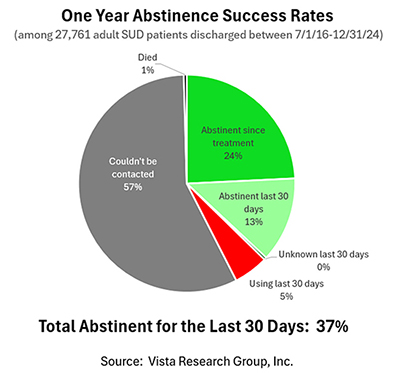
My experience of having to choose which rehab to send my daughter to without the benefit of any effectiveness data led me to start a research company to accurately measure rehab success rates. Ten years later, Vista Research Group has now followed up one year after treatment with 27,761 patients across the U.S. who attended treatment for their addiction.
What we’ve found is that on average, 37% of adult rehab patients report not having used any alcohol or non-prescribed drugs for at least the last 30 days one year after leaving addiction treatment:
This percentage is essentially unchanged since the last federally-funded real-world addiction treatment research (DATOS) was conducted more than 30 years ago.
But Rehab X told me that 85% of their patients were in recovery!
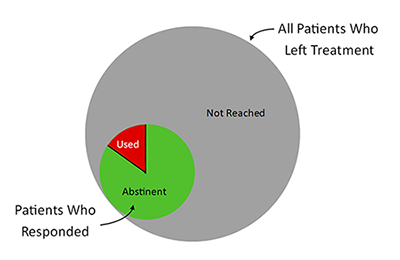
There are a lot of places that will tell you that 80% or more of their patients are abstaining from using drugs or alcohol one year after treatment. Unfortunately, this is b.s. They’re getting responses from a small group (maybe 15% or 20%) of their patients and pretending that this group is representative of everyone else who attended treatment there.
They’re not. If you can’t reach someone, you have to assume they’re using. People who are proud of how they’re doing are eager to respond; those who aren’t, don’t. In reality, Rehab X probably has a success rate of 17% or less, not the 85% they want you to believe:
17% of their patients are abstinent, not 85%
To get accurate data, Vista reaches out 10-15 times by text, email and phone at one month, six months and one year after treatment. We pay the former patients to take our survey, by instantly sending them gift cards. And we even reach out to family members to get better contact information if the patient’s cell phone number no longer works. After all this outreach, if we don’t hear back from a patient, we assume it is because he or she is using again.
But a 37% Success Rate is So Low!
Yes, I know. I wish it was a lot higher too. Fortunately, there are two things you can do to dramatically increase the odds that your family member will recover after treatment:
Choose a treatment center whose outcomes are better than average. Vista’s research shows that there is a tremendous variation in the effectiveness of different rehabs:
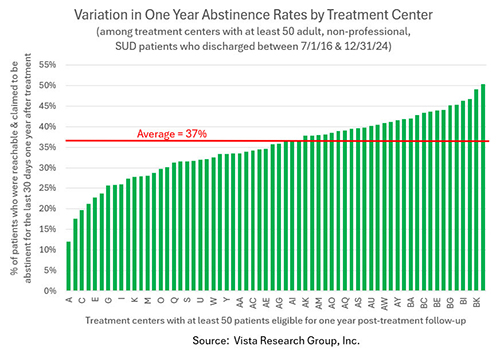
At the best treatment centers, as many as 50% of patients are abstinent one year post-treatment; at the worst, less than 20% are. You can find rehabs whose outcomes are substantially better than average by doing a search on Conquer Addiction’s website.
Help your family member build a strong recovery support system around themselves. Three things in particular have been shown to make a big difference in the likelihood that someone recovers: becoming active in a recovery support community, living in a sober group home after treatment, and creating a randomized drug or alcohol monitoring system.
Rehab isn’t a magic cure—and anyone who tells you it is isn’t being honest. What does make a difference is choosing a program with excellent, validated recovery rates and helping your loved one build a strong recovery support system after treatment.
Joanna
P.S. If this article was useful, please subscribe to receive more research-based advice on helping a loved one recover from addiction each week.